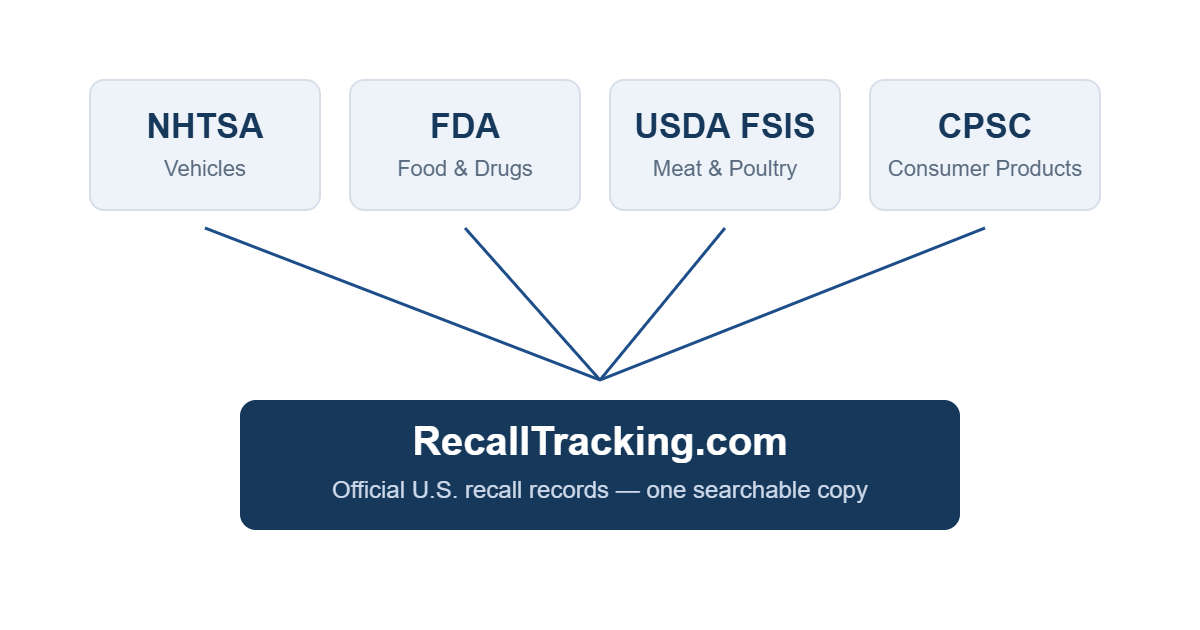
Every recall on this site is drawn from official recall data sources — the four U.S. federal agencies that issue and administer recalls. Nothing here is our opinion of what is or isn’t safe: we republish the government’s own records, and this page explains exactly where each record comes from and how we handle it.
The recall data sources we use
Vehicles — NHTSA. Vehicle recall campaigns come from the National Highway Traffic Safety Administration’s public recall database, covering every campaign filed since 1966 — more than 30,000 campaigns across 74,000+ vehicles. Each recall on this site carries its official NHTSA campaign number, and the problem, risk, and remedy descriptions are the agency’s own text, word for word.
Food & drugs — FDA (coming soon). Food, beverage, dietary-supplement, and medication recalls will come from the U.S. Food & Drug Administration’s recall announcements and enforcement reports. For medication recalls, the only guidance we will ever show is the FDA’s own words, quoted directly and linked to the official notice.
Meat & poultry — USDA FSIS (coming soon). Recalls and public-health alerts for meat, poultry, and egg products will come from the USDA’s Food Safety and Inspection Service.
Consumer products — CPSC (coming soon). Recalls of appliances, toys, furniture, electronics, and other consumer goods will come from the U.S. Consumer Product Safety Commission.
Which recall data sources cover what
The four agencies split responsibility in ways that aren’t always obvious. Vehicles, tires, and child car seats belong to NHTSA. Food is split down the middle: meat, poultry, and egg products are USDA FSIS territory, while nearly everything else — packaged foods, produce, seafood, and dietary supplements — belongs to the FDA, which also covers human and veterinary drugs and medical devices. Toys, appliances, electronics, furniture, and other household goods belong to the CPSC. You don’t need to memorize the map: the search on our homepage covers every category at once, and each result is labeled with the agency it came from.
How we handle the data
We store our own copy of everything our recall data sources publish and refresh it automatically — the “Data updated” indicator in the site header always shows how recently the last successful refresh ran. Every recall keeps its official campaign or recall number and has exactly one page on this site.
Freshness is watched, not assumed: each of our recall data sources is checked on its own schedule, and if a feed stops updating upstream, we’re alerted the same day — a quiet failure at an agency can’t silently freeze what you see here.
We do not edit, summarize, or reinterpret the substance of any official recall text. If an agency corrects or expands a recall, our copy updates on the next refresh. And because these are public government records, we make the same data available to everyone as free bulk downloads — no signup required.
Analysis articles are the exception — and are labeled as such
Articles in our Analysis section are our own original data journalism, computed from the official records. Every analysis article states the date of the data it was computed from, so its findings can be checked against the record as it stood. Articles describe what the data shows, and they are not government publications. Consumer-product articles may suggest replacement products (with any affiliate relationship disclosed); medication articles only ever quote the FDA’s own guidance.
What this site is — and isn’t
RecallTracking.com is an independent reference built on government recall data sources. We are not affiliated with NHTSA, FDA, USDA, or CPSC, and we are not a substitute for them. Records here may lag the agencies’ own sites by a short interval between refreshes. For safety decisions, the issuing agency’s website and the manufacturer’s official notice are always the authoritative sources — every recall page links to its official record, and if the two ever disagree, trust the agency’s live page.
Found an error? Report it through our contact page and include the recall’s campaign number. We check every report against the current record at the issuing agency — the same recall data sources listed above.