Few defects sound as mundane — or read as frightening in owners’ own words — as a worn bushing on a shifter cable. When it degrades or detaches, the transmission may not actually be in Park when the indicator says it is. No warning message, no chime. The driver walks away; the vehicle rolls.
The 2013 Ford Escape recall history includes two campaigns for exactly this. Campaign 18V471 (July 2018) covered 2013–2014 Escapes with six-speed automatic transmissions. Four years later, campaign 22V413 (June 2022) recalled 2013–2019 Escapes for the same failure mode. By that day, 271 complaints describing power-train problems on the 2013 Escape were already in NHTSA’s public database — the earliest filed 3,496 days (9.6 years) before the recall.
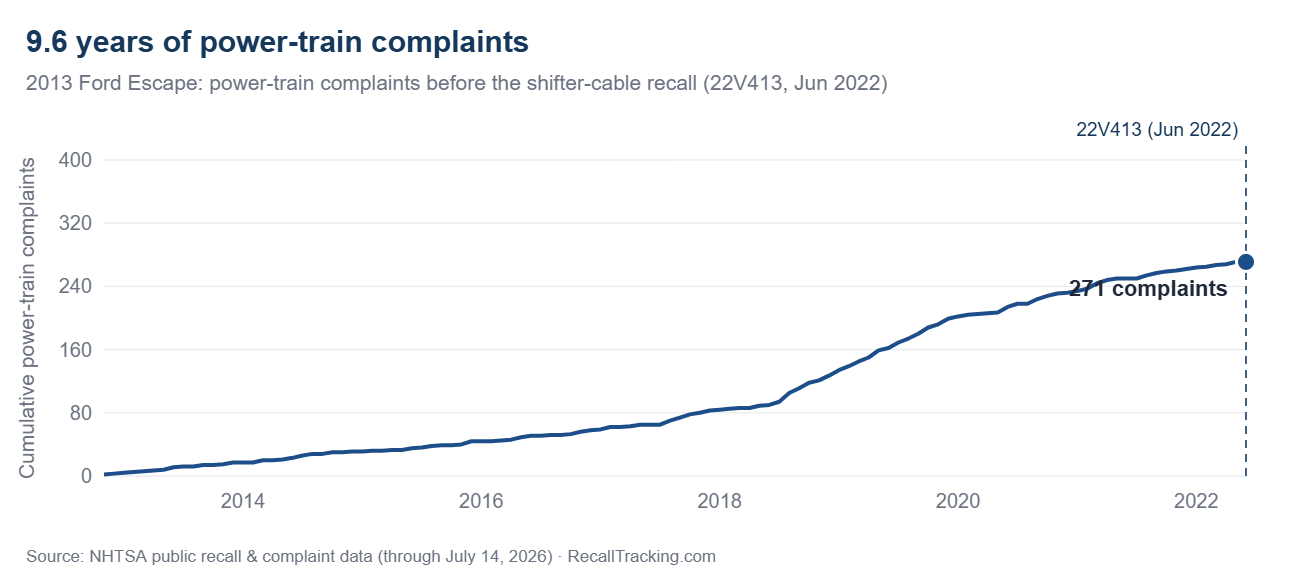
The Ford Escape recall gap: 2018 to 2022
Look at the chart between mid-2018 and mid-2022: the file keeps climbing after the first recall. Part of that stretch is owners whose vehicles fell outside the first campaign’s coverage discovering the same failure — a recurring frustration in the complaint narratives, where owners describe the rollaway experience, look up the 2018 recall, and learn their VIN isn’t included. The 2022 campaign closed much of that gap.
What owners were telling NHTSA
Quoted from NHTSA’s public complaint records (capitalization normalized; checkable by ODI number). Owner reports, not verified findings.
“After backing into the driveway, I moved the shifter into park and turned off the car. I stepped off the brake and the car started rolling down the drive. I was able to put the emergency brake on to stop the rolling.”
— ODI 11361523, filed September 28, 2020
“Transmission linkage bushing crumbled apart and the vehicle rolled out into the parking lot aisle as I was in the store. The car showed it was in park but was actually stuck in gear. This part was recalled in 2018 but my vehicle’s VIN was not part of the recall.”
— ODI 11435038, filed September 30, 2021
“Our 2013 Ford Escape has a VIN that is not covered under recall 18S20… Over the weekend, our car experienced the issue covered in this recall. The Ford dealership will not honor the recall repair because of the VIN, even though the issue has [occurred].”
— ODI 11412810, filed April 19, 2021
(18S20 is Ford’s internal number for NHTSA campaign 18V471.)
What this does — and doesn’t — show
“Power train” is a broad system bucket. Many of those 271 complaints describe transmission problems unrelated to shifter-cable bushings, and complaint data cannot say how many describe the recalled defect. Complaints are self-reported and unverified. The narrow, checkable facts: a 9.6-year-old and steadily growing power-train complaint file existed on the day the 2022 recall arrived, and the same failure mode was recalled twice, four years apart, with progressively wider coverage.
If you own a 2013–2019 Escape
Check your VIN — this is precisely the situation where “my model was recalled years ago” doesn’t mean your vehicle was covered, or fixed. Recall repairs are free at Ford dealers. Check the 2013 Ford Escape recall page or NHTSA.gov, and use the parking brake habitually in the meantime — that isn’t our advice, it’s the standard instruction Ford and NHTSA gave owners awaiting this repair. If your vehicle rolls out of Park, report it to NHTSA.
Ford Escape recall: quick answers
Is there a Ford Escape recall for rolling away?
Yes — two campaigns address shifter-cable bushings that can let the transmission stay in gear when the shifter reads Park: 18V471 (2018) and 22V413 (2022, covering 2013–2019 Escapes).
My Escape wasn’t covered in 2018 — should I check again?
Yes. The 2022 campaign expanded coverage, so a VIN that wasn’t included before may be now. Check at NHTSA.gov or via our 2013 Escape page.
What does the Ford Escape recall repair cost?
Nothing — like all safety-recall remedies, the shifter-cable repair is performed free of charge at Ford dealers.
About the data
Counts are complaints filed with NHTSA describing power-train problems on the 2013 Escape before campaign 22V413’s report date (public records through July 14, 2026; independently re-verified July 15, 2026). Campaigns 18V471 and 22V413 and every ODI number can be checked at NHTSA.gov. Definitions and limitations: the methodology section of our flagship study. Part of The Warnings Were There series.