Before a car is recalled, someone usually saw it coming — and told the government, in writing.
We analyzed 109 safety recalls across 11 popular U.S. vehicles, together with all 20,495 consumer complaints owners filed about those vehicles with the National Highway Traffic Safety Administration. In 69 of the 109 recalls — 63% — at least ten complaints describing problems with the same vehicle system were already sitting in NHTSA’s public database on the day the recall was reported. Half of those 69 recalls came more than 4.9 years after the first same-system complaint. The longest warning window ran 4,020 days — eleven years.
The complaints were public the whole time. Anyone could have read them. That is what we mean by car recall warning signs, and it is the finding of this study: not that manufacturers ignored warnings — our data cannot show what anyone knew or did — but that for most recalls in this sample, the public record contained warning signs years before the recall existed.
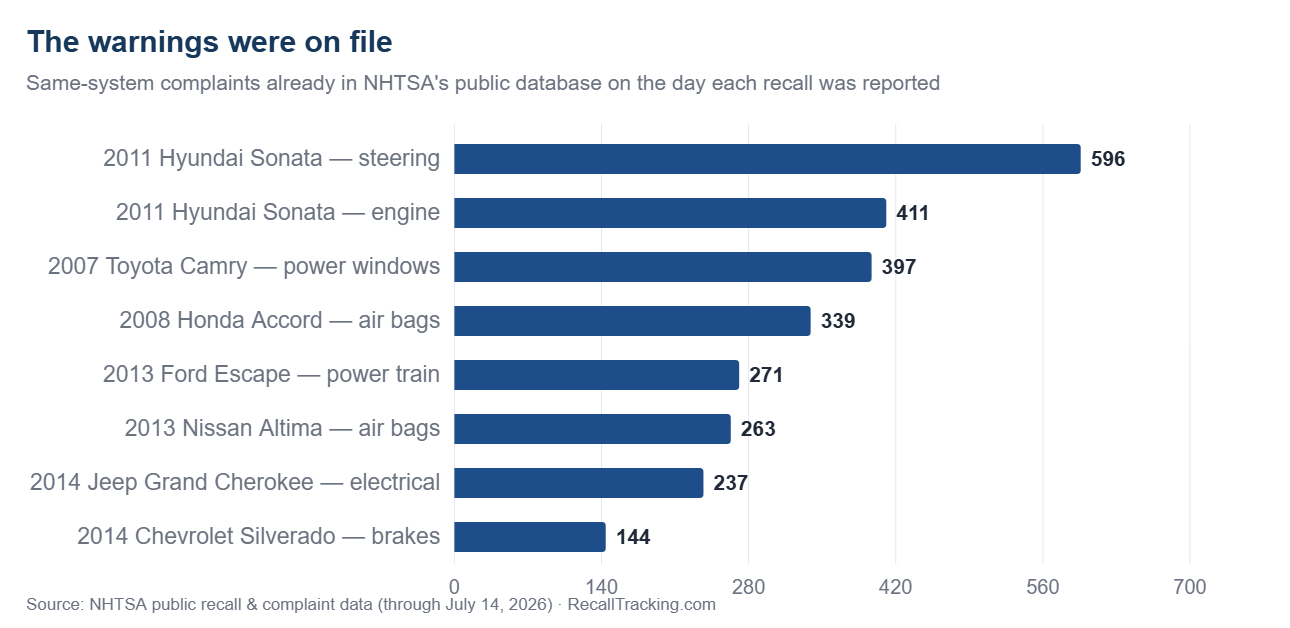
Car recall warning signs, by the numbers
- 63% of the 109 recalls (69 recalls) were preceded by 10 or more complaints filed with NHTSA describing problems with the same vehicle system.
- The median warning window among those 69 recalls — first same-system complaint to recall report — was 1,775 days, about 4.9 years. In 32 of the 69, the window exceeded five years.
- 25 recalls had one hundred or more same-system complaints on file before they were reported.
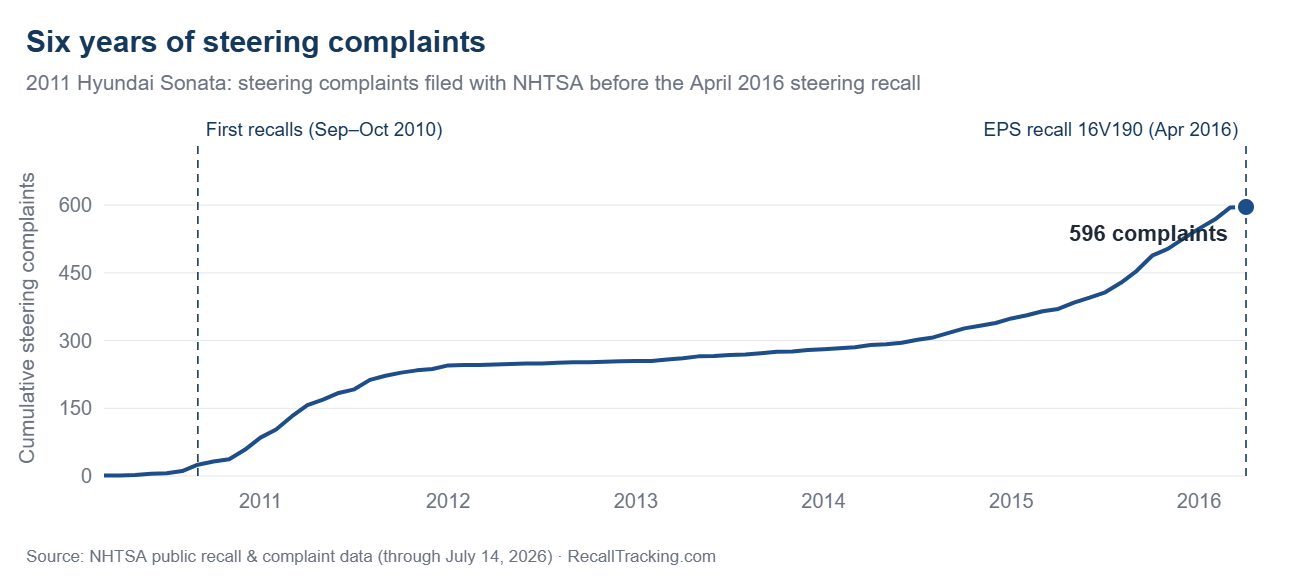
- The largest single backlog: 596 complaints about steering on the 2011 Hyundai Sonata before its April 2016 steering recall (campaign 16V190).
What “warning signs” means here — and what it doesn’t
One thing must be clear before the tables: a complaint is not a confirmed defect. NHTSA complaints are self-reported by vehicle owners and are not individually verified. And our matching is deliberately coarse — we count complaints about the same vehicle system (steering, brakes, air bags), not about the exact defect that was eventually recalled. An oil-leak complaint and an engine-fire recall both land in the ENGINE bucket. The full matching rules, definitions, and limitations are on our methodology section at the end of this article — and every figure can be checked against the public records at NHTSA.gov.
Eight recalls, eight backlogs of complaints
The table shows the recall with the largest pre-recall complaint count for each vehicle-and-system pairing in our sample’s top ranks. Where a system was recalled more than once (the Accord’s passenger air-bag inflators were recalled six times), we show a single campaign — the campaigns overlap and largely share the same complaint pool, so their counts must never be added together.
| Vehicle & system | Recall (campaign) | Recall reported | Same-system complaints already on file | Warning window |
|---|---|---|---|---|
| 2011 Hyundai Sonata — steering | 16V190 | Apr 2016 | 596 | 6.0 years |
| 2011 Hyundai Sonata — engine | 18V934 | Dec 2018 | 411 | 8.8 years |
| 2007 Toyota Camry — power windows* | 15V689 | Oct 2015 | 397 | 9.0 years |
| 2008 Honda Accord — air bags | 19V502 | Jun 2019 | 339 | 11.0 years |
| 2013 Ford Escape — power train | 22V413 | Jun 2022 | 271 | 9.6 years |
| 2013 Nissan Altima — air bags | 16V911 | Dec 2016 | 263 | 4.2 years |
| 2014 Jeep Grand Cherokee — electrical | 18V332 | May 2018 | 237 | 5.0 years |
| 2014 Chevrolet Silverado 1500 — brakes | 19V761 | Oct 2019 | 144 | 5.6 years |
*NHTSA files the Camry master-power-window-switch campaign under its “visibility” component family; counts reflect that system grouping.
Case study: six years of steering complaints
On March 29, 2010, an owner of a 2011 Hyundai Sonata filed a complaint with NHTSA describing a steering problem — the first of many. It carries ODI number 10322666; you can look it up. Over the following six years, owners filed 595 more complaints describing steering problems with that model year, nine of them reporting crashes. On April 5, 2016, NHTSA received Hyundai’s defect report for what became campaign 16V190 — a recall for electronic power-steering circuit boards that could fail and cause a loss of power-steering assist. By that day, 596 steering complaints about the 2011 Sonata were already in the public database.
Nothing in complaint data can tell us whether those 596 complaints described the exact defect that was recalled — many likely did not. What the record shows is narrower and still striking: for six years, a growing public file of steering complaints existed for a vehicle that would eventually get a steering recall.
Nine and a half years, then a rollaway recall
The 2013 Ford Escape shows the same shape on a different system. In June 2022, Ford reported campaign 22V413: the bushing attaching the shifter cable to the transmission could degrade or detach — meaning the transmission might not actually be in Park when the indicator says it is. By that day, 2013 Escape owners had filed 271 complaints describing power-train problems with NHTSA, the earliest 3,496 days — 9.6 years — before the recall was reported.
The usual caution applies with extra force here: “power train” is a broad system bucket, and many of those 271 complaints will describe transmission problems unrelated to a shifter-cable bushing. The narrow, checkable fact is the size and age of the same-system complaint file on the day the recall arrived.
The eleven-year window
The longest warning window in our sample belongs to the 2008 Honda Accord’s air bags — the Takata inflator saga. By the time the final campaign in the series (19V502) was reported in June 2019, owners had filed 339 complaints describing air-bag problems with the 2008 Accord, and the earliest dated back 4,020 days — eleven years.
Those complaints reported 44 injuries and 35 crashes (reported by the complainants themselves; NHTSA does not verify them, and they cannot be attributed to the recalled defect from complaint data alone). The 2008 Accord’s passenger air-bag inflators were recalled six separate times between 2016 and 2019 as the Takata recalls expanded — one reason we count each campaign separately and never total them.
The other 37% — recalls nobody saw coming
Honesty requires the counterweight: 40 of the 109 recalls had fewer than ten same-system complaints on file when they were reported, and 12 had none at all. Some defects genuinely surface first inside the manufacturer — through warranty data, internal testing, or supplier notices — and reach NHTSA as a recall before owners ever connect their symptoms to a defect and file. The median recall in our sample had 20 same-system complaints on file; the distribution is wildly uneven, from zero to 596. The complaint database is a warning system that fires often, not always.
It can also fire without a recall ever following. In this same sample, roughly half the vehicle systems that accumulated 200 or more complaints have never been recalled at all — a finding big enough that we’re giving it its own analysis. High complaint volume is a signal worth watching, not proof of a defect.
Warning windows by manufacturer — handle with care
Median warning windows in our sample range from under two years to over eight, but the per-make numbers rest on small samples — a handful of recalls for one or two models per make — so we present them as a table, not a ranking, and they say nothing about any manufacturer’s overall behavior.
| Make (models in sample) | Recalls | With 10+ prior same-system complaints | Median warning window |
|---|---|---|---|
| Honda (2008 Accord, 2015 CR-V) | 12 | 10 | 8.1 years |
| Kia (2013 Optima) | 9 | 8 | 6.1 years |
| Hyundai (2011 Sonata) | 14 | 11 | 4.9 years |
| Toyota (2007 Camry, 2013 RAV4) | 12 | 5 | 4.3 years |
| Jeep (2014 Grand Cherokee) | 19 | 12 | 2.9 years |
| Chevrolet (2011 Cruze, 2014 Silverado 1500) | 13 | 9 | 2.7 years |
| Ford (2013 Escape) | 18 | 7 | 1.9 years |
| Nissan (2013 Altima) | 12 | 7 | 1.8 years |
Long windows aren’t automatically damning, either: vehicles age, defects emerge slowly, and a recall reported twelve years after a model year necessarily has a long possible window. The honest framing is the one we opened with — the public record contained warning signs — and even that comes with the caveat that this is a hand-picked sample of 11 popular, recall-heavy vehicles, not a random slice of the market. These numbers do not generalize to all recalls.
Why this matters to you
Two practical facts fall out of this study. First, the complaint database is not a void — complaints accumulate in public, recalls follow the same systems people complained about often enough that the pattern is visible, and regulators and reporters read these files. When you report a safety problem to NHTSA, it becomes part of exactly the record this study measured. Second, recalls routinely arrive years after problems start being reported — which means a recall may exist today for a problem your car developed years ago, or a recall may arrive years from now for a vehicle you’ve stopped thinking about.
NHTSA’s guidance to owners is direct: check for open recalls using your VIN, and if your vehicle has one, contact your dealer — recall repairs are performed free of charge. You can check any vehicle in seconds with our vehicle recall lookup, or at NHTSA’s own nhtsa.gov/recalls.
How this study was done (methodology & limitations)
Every number in this article — and in the rest of our recall analysis series, which links back to this section — comes from NHTSA’s public recall and complaint records for 11 high-selling U.S. vehicles: 109 recalls and 20,495 consumer complaints, pulled July 14, 2026, and independently re-run and re-verified July 15, 2026. This research can be verified against the records available through NHTSA.gov — every recall we cite carries its official campaign number and every complaint its ODI number.
The 11 vehicles
We hand-picked popular, high-selling models from recall-heavy generations — the vehicles millions of readers actually own. That means this sample runs recall-heavier than the average vehicle, and nothing here generalizes to “all recalls.”
| Vehicle | Recalls | Complaints |
|---|---|---|
| 2011 Hyundai Sonata | 14 | 3,368 |
| 2007 Toyota Camry | 10 | 3,613 |
| 2013 Ford Escape | 18 | 2,743 |
| 2014 Jeep Grand Cherokee | 19 | 2,369 |
| 2013 Nissan Altima | 12 | 2,304 |
| 2014 Chevrolet Silverado 1500 | 6 | 1,554 |
| 2008 Honda Accord | 9 | 1,520 |
| 2013 Kia Optima | 9 | 1,371 |
| 2011 Chevrolet Cruze | 7 | 731 |
| 2015 Honda CR-V | 3 | 668 |
| 2013 Toyota RAV4 | 2 | 254 |
| Total | 109 | 20,495 |
How we counted
The recall date is the day NHTSA received the manufacturer’s official defect report — the earliest public date of the recall. Pre-recall complaints are complaints about the same vehicle system filed before that date; a recall “had warning signs” if at least 10 were on file. The warning window runs from the earliest same-system complaint to the recall date.
Matching is at the system level — NHTSA labels both recalls and complaints by component system (steering, brakes, air bags), and an oil-leak complaint and an engine-fire recall both count as “engine.” So our counts mean “complaints about the same vehicle system,” never “complaints about this exact defect.” A companion analysis (recall rate by complaint volume) uses the same records across 242 vehicle-system pairings.
What these numbers can’t tell you
The sample is hand-picked, not random. System-level matching overcounts. When one system is recalled several times (the 2008 Accord’s passenger air-bag inflators were recalled six times), the campaigns largely share the same pool of complaints, so we never add them together. NHTSA complaints are self-reported and not individually verified — injuries and deaths mentioned in them doubly so, which is why we never attribute a death to a defect from complaint data.
Correlation is not causation: popular vehicles generate both more complaints and more recalls. And long warning windows partly reflect aging vehicles, not necessarily slow manufacturers — the claim we stand behind is that the public record contained warning signs, not that anyone ignored them.
Our language rules
Complaints are “complaints describing X problems,” never “confirmed defects”; injuries are “reported in complaints,” never “caused by the defect”; the sample is always “109 recalls across 11 popular models,” never “all recalls”; high complaint volume is a signal worth watching, never proof of a defect or of wrongdoing. How the live site’s own recall database works (a separate system from this study): data sources & methodology. Journalists and researchers are welcome to cite these findings with attribution and a link. Questions or corrections: contact us.