The problem, as hundreds of owners described it, was a light that wouldn’t behave: the indicator showing the front passenger air bag was OFF — with a full-grown adult sitting in the seat.
Behind that light is the occupant classification system (OCS), the sensor package that decides whether the passenger air bag should deploy. On the 2013 Nissan Altima, that system produced four Nissan Altima air bag recall campaigns in four years: 13V069 (March 2013), 15V681 (October 2015), 16V244 (April 2016), and 16V911 (December 2016). By the time the fourth campaign was reported, 263 complaints describing air-bag problems on the 2013 Altima were on file with NHTSA — 13 of them reporting injuries and 16 reporting crashes (owner-reported figures NHTSA does not verify).
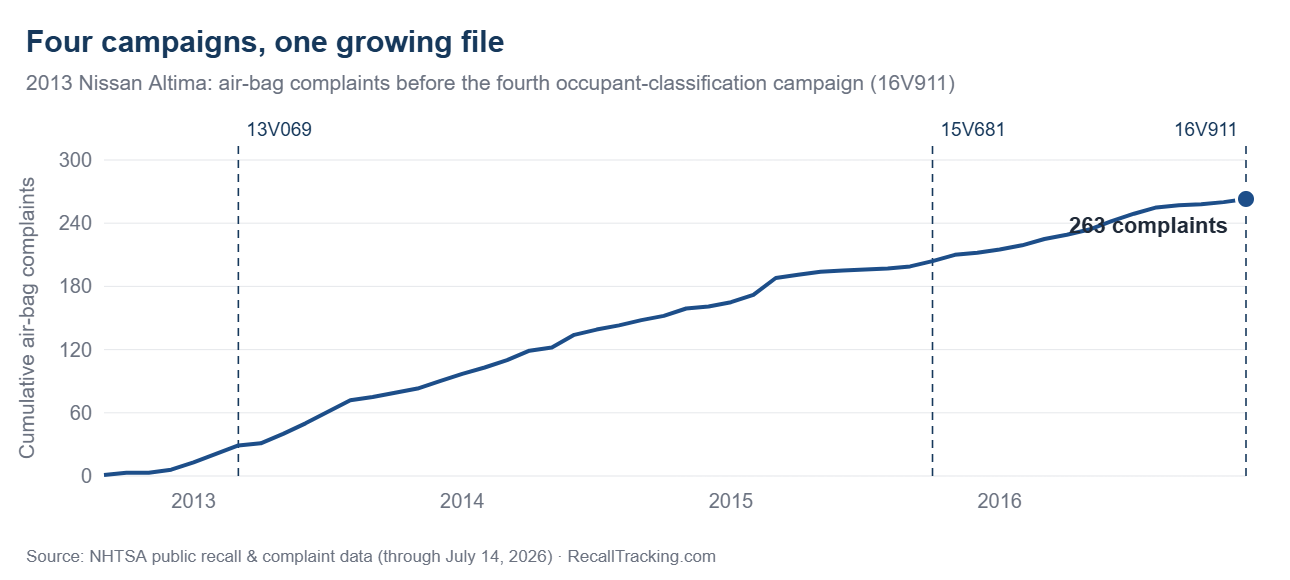
Four Nissan Altima air bag recall campaigns, one sensor
The campaigns tell their own story. The first, weeks into the model year, recalled occupant-detection sensors “manufactured out of specification” that could permanently suppress the passenger air bag. The second addressed vehicles that received an incorrect OCS control unit during a repair. The third and fourth widened the net again for OCS software and hardware. A recall that has to be revisited is not unusual — remedies are engineered under time pressure — but four campaigns on one system is the kind of sequence that complaint files make visible.
What owners were telling NHTSA
Quoted from NHTSA’s public complaint records (capitalization normalized; checkable by ODI number). Owner reports, not verified findings.
“The airbag sensor for the front passenger seat does not work properly. On multiple occasions, when a 120–130 lb female is sitting in the passenger seat, the detection system and warning light suggest the air bag has been shut off. There is a recall for Nissan Altimas of my model year, but not my vehicle.”
— ODI 10511054, filed May 8, 2013
“The passenger seat air bag occupant sensor comes on showing that the passenger air bag is turned off when an adult is sitting in the seat. The adult is 200 lbs… My car was recalled for the occupant sensor classification reset. It did not change anything. It still does the same thing.”
— ODI 10783624, filed October 20, 2015
“I have had an issue with the passenger’s side airbag for 3 years now. You can have a 140 up to a 300 pound passenger in the seat and the air bag turns off… Per Nissan yesterday… a new recall is coming. This has been 3 years now.”
— ODI 10873405, filed June 9, 2016 — six months before campaign 16V911 was reported
What this does — and doesn’t — show
The 263 figure counts complaints about the air-bag system broadly, not the OCS specifically, and complaint data cannot say how many describe any recalled defect. Complaints are self-reported and unverified. But this file is unusually coherent: read the narratives and the same scene repeats for years — an adult in the passenger seat, an OFF light that shouldn’t be on, a dealer visit that doesn’t resolve it. The final quote above, an owner relaying in mid-2016 that “a new recall is coming,” was filed six months before it did.
If you own a 2013 Altima
Four campaigns, four chances one applies to your VIN. Check the 2013 Nissan Altima recall page or NHTSA.gov; recall repairs are free at Nissan dealers. If your passenger air-bag light behaves this way, report it to NHTSA.
Nissan Altima air bag recall: quick answers
What is the Nissan Altima air bag recall about?
The occupant classification system — the sensors deciding whether the passenger air bag should deploy — could wrongly read an occupied seat as empty and switch the air bag off.
How many campaigns did it take?
Four in four years: 13V069 (2013), 15V681 (2015), 16V244 and 16V911 (2016). Each widened or revised the remedy; coverage is VIN-specific.
My passenger air-bag light still acts up — now what?
Per NHTSA’s standing guidance: have a dealer inspect it, confirm all open recalls are completed via your VIN, and report the problem to NHTSA.
About the data
Counts are complaints filed with NHTSA describing air-bag problems on the 2013 Altima before campaign 16V911’s report date (public records through July 14, 2026; independently re-verified July 15, 2026). All four campaign numbers and every ODI number can be checked at NHTSA.gov. Definitions and limitations: the methodology section of our flagship study. Part of The Warnings Were There series.