The complaints describe the same moment again and again: the pedal goes hard, the truck keeps moving. Backing a boat down a ramp. A deer in the headlights on a two-lane highway. A panic stop that takes too long.
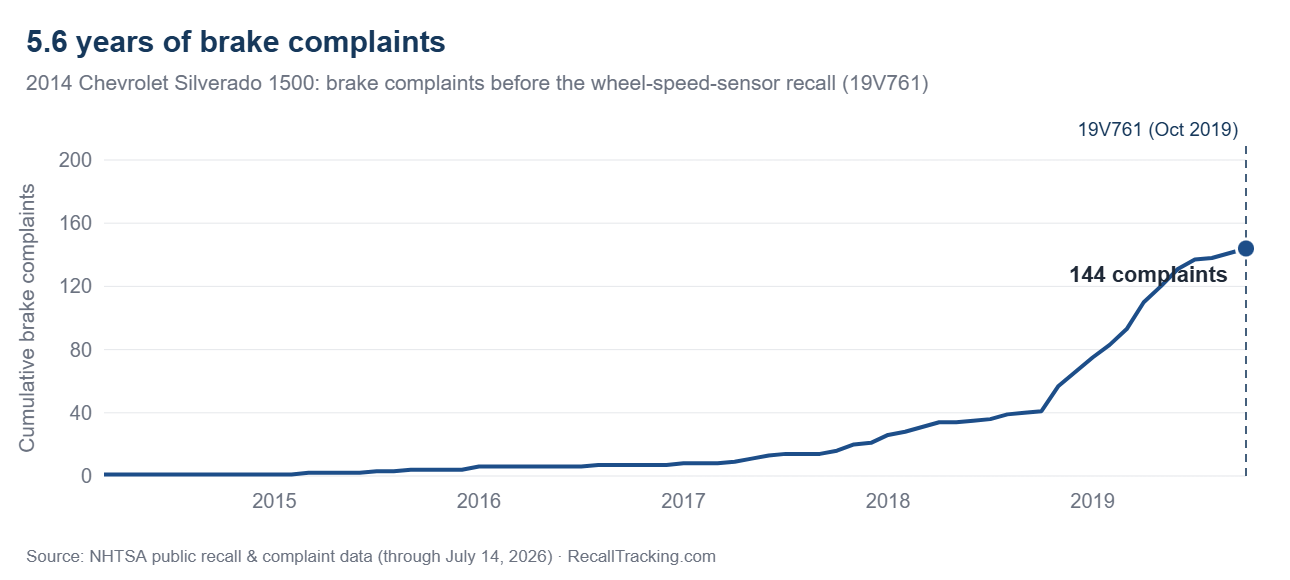
In the fall of 2019, the 2014 Chevrolet Silverado 1500 received two brake recalls seven weeks apart — the Silverado brake recall story is really two stories. Campaign 19V645 (September 6, 2019) addressed vacuum pumps whose output can decline, increasing braking effort and stopping distance. Campaign 19V761 (October 24, 2019) addressed wheel-speed sensor failures that can cause unwanted ABS activation on four-wheel-drive trucks. By the second campaign’s report date, 144 complaints describing brake problems on the 2014 Silverado were on file with NHTSA — the earliest filed 5.6 years before.
Inside the Silverado brake recall file
Look at the chart: this is not a file that grew steadily. For four years the 2014 Silverado logged a handful of brake complaints — background noise. The curve bends upward through 2018 and then climbs steeply through 2019, with dozens of near-identical hard-pedal reports arriving in the months before the recalls. The file stood at just 16 complaints in late 2017; 128 of the eventual 144 arrived in the final two years.
What owners were telling NHTSA
Quoted from NHTSA’s public complaint records (capitalization normalized; checkable by ODI number). Owner reports, not verified findings.
“For the past 2 months I was noticing it was getting hard to stop my truck… a deer ran out in front of me, I applied the brakes and swerved… I went across the highway and into the woods with my truck and had both feet on the brake pedal and it was like I had no brakes.”
— ODI 11220951, filed June 18, 2019
“Loss of braking power has occurred multiple times at the boat ramp. While slowly backing down the ramp in reverse, brakes will become stiff and not stop the truck… My truck has almost not stopped and rolled into the water on a few occasions now.”
— ODI 11219869, filed June 13, 2019
“During a panic stop at slow to mid speed someone pulled out in front of me and I hit the brakes only to have a hard pedal and not stopping quick enough… The hard pedal and increased stopping distance is a definite safety issue and I will be heading to the dealer ASAP.”
— ODI 11242706, filed August 8, 2019
What this does — and doesn’t — show
The brakes bucket includes complaints of many kinds — worn pads, warning lights, ABS behavior — and complaint data cannot say how many of the 144 describe either recalled defect. Complaints are self-reported and unverified. The checkable facts: a brake complaint file that surged in 2018–2019, followed within months by two brake campaigns; and pre-recall counts of 138 (at 19V645) and 144 (at 19V761) — snapshots of one growing file, never to be added together.
If you own a 2014–2018 Silverado
Both campaigns are old enough to be forgotten and recent enough to be unrepaired. Check your VIN on the 2014 Chevrolet Silverado 1500 recall page or at NHTSA.gov; recall repairs are free at GM dealers. If your brake pedal hardens or stopping distance grows, report it to NHTSA.
Silverado brake recall: quick answers
Which campaigns make up the 2014 Silverado brake recall picture?
Two, seven weeks apart in fall 2019: 19V645 (vacuum pumps that can lose output, increasing stopping distance) and 19V761 (wheel-speed sensor failures causing unwanted ABS activation on 4WD trucks).
What did owners report before the recalls?
The dominant theme in pre-recall complaints is a hard brake pedal and longer stops — 128 of the 144 pre-recall complaints arrived in the final two years before the campaigns.
Is my truck covered?
Coverage is VIN-specific across 2014–2018 trucks. Check at NHTSA.gov or our 2014 Silverado page; repairs are free at GM dealers.
About the data
Counts are complaints filed with NHTSA describing brake problems on the 2014 Silverado 1500 before each campaign’s report date (public records through July 14, 2026; independently re-verified July 15, 2026). Campaigns 19V645 and 19V761 and every ODI number can be checked at NHTSA.gov. Definitions and limitations: the methodology section of our flagship study. Part of The Warnings Were There series.