A recall usually arrives after complaints pile up. But sometimes the complaints pile up and the recall never comes.
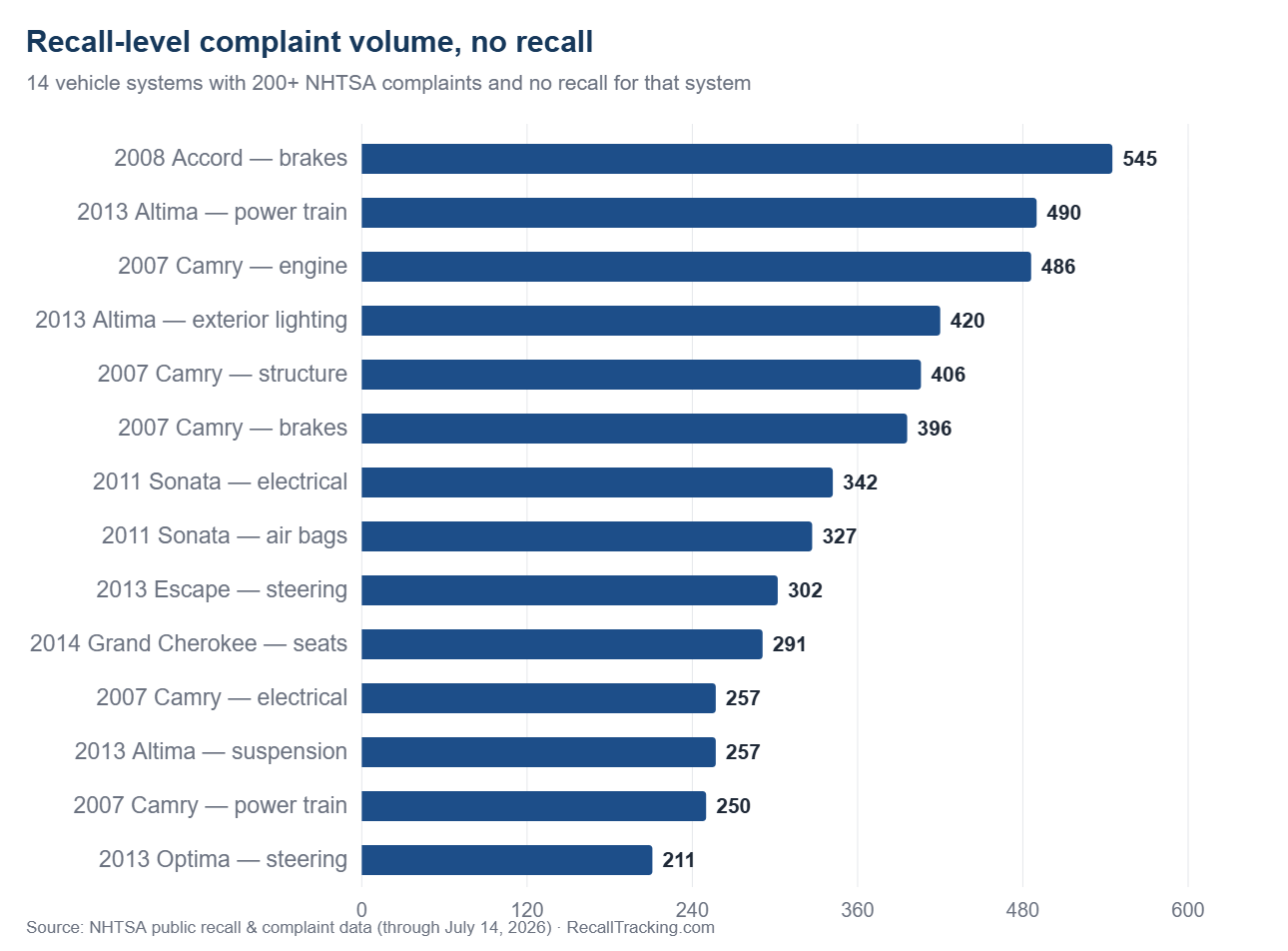
In our analysis of 11 popular U.S. vehicles — 109 recalls and 20,495 owner complaints filed with NHTSA — we found that vehicle systems with 200 or more complaints had been recalled about 48% of the time. This page is our recall watchlist — the other half: 14 vehicle systems that have accumulated 200+ complaints each and have never been recalled for that system. Together they hold nearly 5,000 complaints.
First, what this list is not
This is the most important section of the page. Complaint volume is not proof of a defect. NHTSA complaints are self-reported by owners and not individually verified. Popular vehicles generate more complaints simply because more of them are on the road. Some complaint categories describe wear-and-tear and durability frustrations — real problems for owners’ wallets, but not necessarily the kind of safety defect that triggers a recall.
Nothing on this list implies wrongdoing by any manufacturer, and none of these systems has been found defective. What the list shows is narrower: these systems have accumulated complaint volumes that, elsewhere in the same dataset, were about as likely as not to be associated with a recall.
The recall watchlist
| # | Vehicle & system | Complaints | What complaints commonly describe |
|---|---|---|---|
| 1 | 2008 Honda Accord — brakes | 545 | Premature rear-brake wear; ABS/VSA module problems |
| 2 | 2013 Nissan Altima — power train | 490 | CVT transmission failures, shuddering, loss of power |
| 3 | 2007 Toyota Camry — engine | 486 | Excessive oil consumption; engine damage from low oil |
| 4 | 2013 Nissan Altima — exterior lighting | 420 | Headlight lens hazing and dimming |
| 5 | 2007 Toyota Camry — structure | 406 | Melting/sticky dashboards, sun-glare complaints |
| 6 | 2007 Toyota Camry — brakes | 396 | Brake actuator noise and pedal behavior |
| 7 | 2011 Hyundai Sonata — electrical | 342 | Electrical faults, stalling, warning lights |
| 8 | 2011 Hyundai Sonata — air bags | 327 | Air-bag warning lights; non-deployment reports |
| 9 | 2013 Ford Escape — steering | 302 | Power-steering assist faults, steering lock-ups |
| 10 | 2014 Jeep Grand Cherokee — seats | 291 | Seat frame and adjuster problems |
| 11 | 2007 Toyota Camry — electrical | 257 | Assorted electrical faults |
| 12 | 2013 Nissan Altima — suspension | 257 | Premature strut and control-arm wear |
| 13 | 2007 Toyota Camry — power train | 250 | Transmission hesitation and harsh shifting |
| 14 | 2013 Kia Optima — steering | 211 | Steering-coupler wear: clicking, play, shaking |
Complaint counts are complaints filed with NHTSA describing problems in that vehicle system (any date, through July 14, 2026). “What complaints commonly describe” summarizes the dominant themes we found reading the most recent complaint narratives for each system — it is a description of what owners report, not a defect finding.
What’s actually in these complaint files
Numbers alone can mislead, so we read the recent complaint narratives behind every entry above. A few patterns stand out. The 2008 Accord’s brake complaints — the largest file on the list — are dominated by premature rear-brake wear, a durability complaint that was the subject of civil litigation years ago rather than a federal safety recall; a smaller thread describes ABS modulator failures. The 2013 Altima’s power-train file reads as one long account of CVT transmission trouble: shuddering, hesitation, sudden loss of power — a well-known ownership complaint for Altimas of this generation that has produced extended warranties but no recall for this model year’s transmission.
The 2007 Camry’s engine file is overwhelmingly about excessive oil consumption. The 2013 Escape’s steering file is strikingly consistent — hundreds of owners describing the same “steering assist fault” message and lock-ups — and it is still growing in 2026. The 2013 Optima’s steering file converges on one part: the motor-driven power steering flexible coupler.
Consistency cuts both ways. A coherent complaint file can mean owners are describing a real common failure — or that a vehicle community has settled on a shared explanation for ordinary aging. Only an investigation can tell the difference, and that is NHTSA’s job, not ours.
Why high-complaint systems go unrecalled
Several boring explanations cover most cases. Recalls address safety defects, and many high-complaint categories — oil consumption, brake wear, transmission performance — often fail as reliability problems rather than immediate safety hazards. Some issues get addressed through technical service bulletins, extended warranties, or settlements instead of recalls. And these are all high-selling vehicles: big fleets generate big complaint counts on every system.
What happens next
This is a living page. Recalls routinely arrive years after complaints begin — in this same dataset, half the recalls with warning signs came more than 4.9 years after the first same-system complaint (see our study of 109 recalls). If any system on this list is recalled, we will update this page and report it. If you own one of these vehicles, the practical steps are the official ones: check your VIN for open recalls with our vehicle recall lookup or at NHTSA.gov, and if you experience a safety problem, report it to NHTSA — complaints like yours are exactly what this data is made of.
Recall watchlist: quick answers
What is a recall watchlist?
Ours is a data-tracking page: vehicle systems whose NHTSA complaint volume (200+) matches levels where, elsewhere in the same dataset, a recall existed about half the time — but which have no recall for that system. It is a signal tracker, not a defect list.
Does being on the recall watchlist mean these vehicles are dangerous?
No. Complaints are unverified owner reports, and high volume often reflects popularity or durability frustrations rather than a safety defect. Nothing on this page is a defect finding, and no wrongdoing is implied.
What should I do if my vehicle appears here?
The official steps: check your VIN for open recalls at NHTSA.gov or our vehicle lookup, and if you experience a safety problem, report it to NHTSA — records like those are what make a recall watchlist possible.
About the data
Counts come from NHTSA’s public complaint and recall records for 11 popular vehicles (data through July 14, 2026), matched at the vehicle-system level. Every count can be verified against the public records at NHTSA.gov. Full definitions, matching rules, and limitations: the methodology section of our flagship study.