The complaints read like small emergencies: smoke curling out of the driver’s door panel, a melted switch, a driver pouring water on the armrest at the side of the road. For years, owners of the 2007 Toyota Camry filed reports like these with NHTSA about the power-window master switch — the control cluster on the driver’s door.
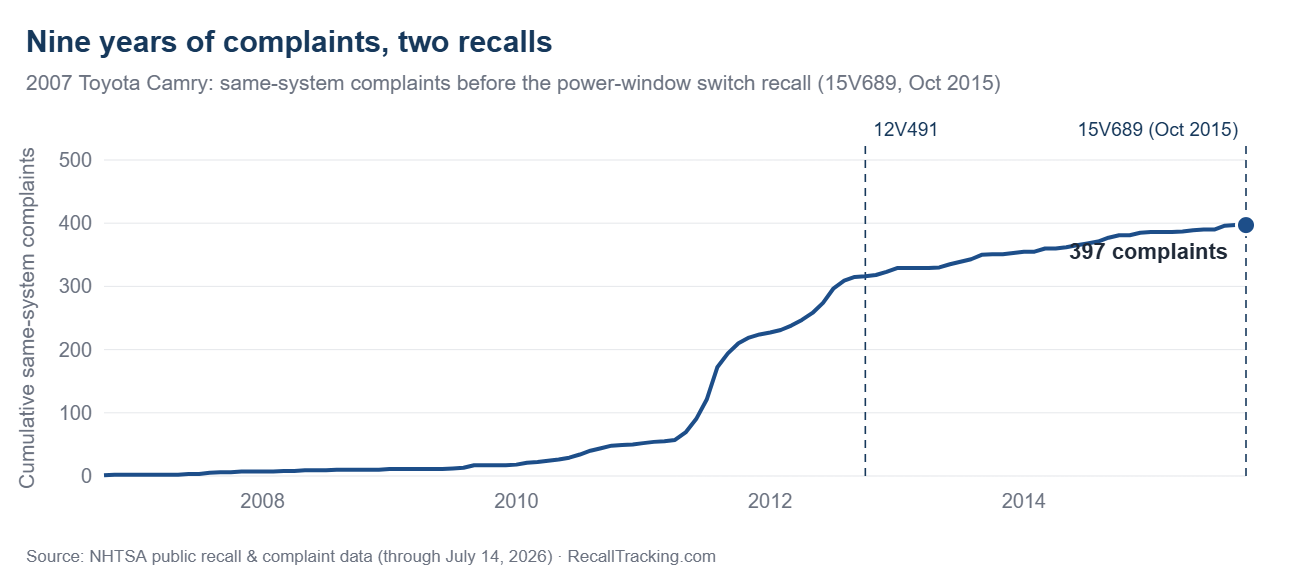
The Toyota Camry power window recall actually happened twice. Campaign 12V491 (October 2012) covered the master switch on the 2007–2009 Camry and several other models; by its report date, 316 same-system complaints were on file for the 2007 Camry. Three years later, campaign 15V689 (October 2015) — a much larger multi-model campaign spanning Camrys, Corollas, RAV4s, Highlanders, and more — swept in the 2007 Camry again. By then the file had grown to 397 complaints, the earliest filed nine years before.
A note on the odd category name
NHTSA files power-window components under its “visibility” system family — windows are, after all, what you see through. So the counts here are complaints in that system family, which also includes windshields, wipers, and sunroofs. As with every article in this series, “same-system complaints” means exactly that — not “complaints about the exact recalled switch.” The dominant theme in this particular file, though, is unmistakable: window switches that overheat, smoke, and melt. Four of the pre-recall complaints reported fires.
What owners were telling NHTSA
All three complaints below were filed before the first recall in October 2012. Quoted from NHTSA’s public records (capitalization normalized; checkable by ODI number). Owner reports, not verified findings.
“The contact started the vehicle, activated the air conditioner and smoke emitted from the driver side door module. A small fire then erupted… The contact was able to remove the door module and found that the window power switch was melted.”
— ODI 10461220, filed June 11, 2012
“While driving 25 mph, he smelled an odor of smoke… and noticed smoke coming from the control panel of the window… The dealer stated that they had to replace the master switch for the windows.”
— ODI 10462247, filed June 19, 2012
“While driving 25 mph, a smoke odor came from the window control panel. The contact then poured water over the control panel to stop the panel from igniting into flames.”
— ODI 10450807, filed March 8, 2012
Two Toyota Camry power window recall campaigns, three years apart
The chart’s most interesting stretch is 2012–2015: the 2012 recall did not stop the file from growing. Some of that is owners whose switches failed after the first campaign, some is the broader visibility category collecting unrelated complaints, and some is the familiar pattern of a recall teaching owners what to report. In 2015, the second, far larger campaign arrived; per the official recall notice, dealers inspect the switch and apply the remedy free of charge.
If you own a 2007–2011 Camry
These campaigns are more than a decade old, but recall repairs don’t expire with the news cycle — check whether yours was ever performed. Look up your VIN on the 2007 Toyota Camry recall page or at NHTSA.gov. If a window switch in any vehicle smokes or melts, NHTSA’s guidance is to report it.
Toyota Camry power window recall: quick answers
What is the Toyota Camry power window recall about?
Two campaigns — 12V491 (2012) and 15V689 (2015) — address the driver’s-door power window master switch, which can overheat. Complaint narratives describe smoke and melted switches.
Which model years are covered?
Coverage differs by campaign and is VIN-specific; the 2007 Camry appears in both. Run your VIN at NHTSA.gov or start at our 2007 Camry recall page.
Is the repair still free a decade later?
Safety-recall repairs are performed free of charge at Toyota dealers — a VIN check takes about two minutes and settles whether yours was ever done.
About the data
Counts are complaints filed with NHTSA in the same system family before each campaign’s report date, from public records for 11 popular vehicles (data through July 14, 2026; independently re-verified July 15, 2026). Campaigns 12V491 and 15V689 and every ODI number can be checked at NHTSA.gov. Definitions and limitations: the methodology section of our flagship study. Part of The Warnings Were There series.