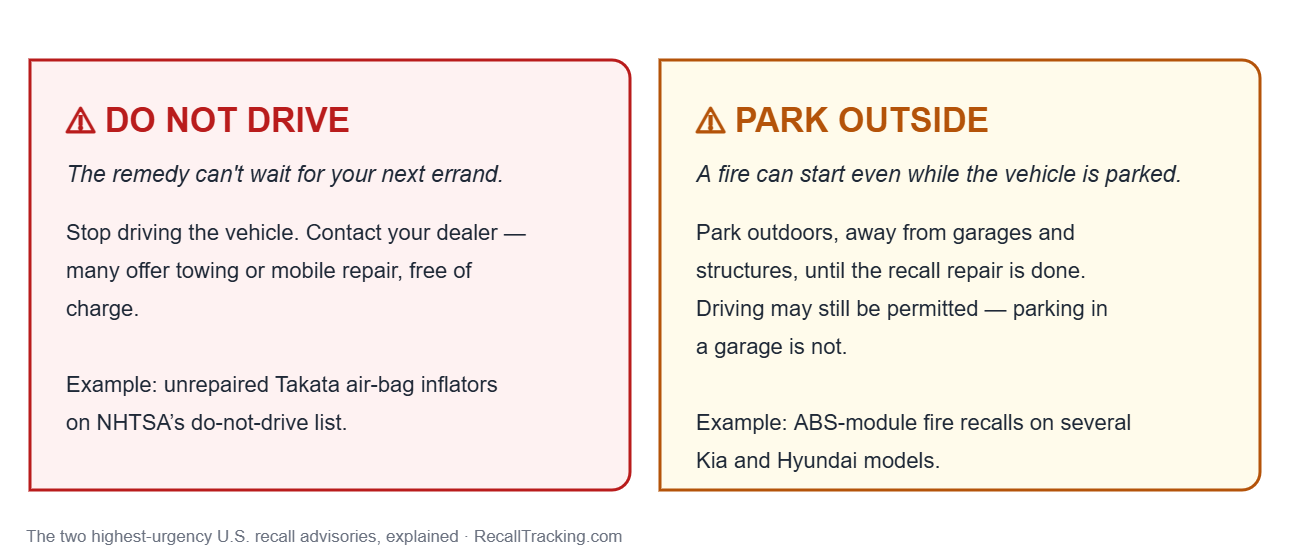
Most recalls come with an unhurried instruction: schedule a free repair when convenient. Two kinds do not — the do not drive recall and its park-outside sibling. A do-not-drive advisory means the vehicle shouldn’t be driven at all until it’s fixed. A park-outside advisory means it shouldn’t be parked in your garage — because the defect can start a fire even when the vehicle is off.
The do not drive recall: the danger rides with you
A do-not-drive advisory attaches to defects where the act of driving is the danger — an air bag that can rupture in a fender-bender, steering that can fail outright. The instruction, in NHTSA’s own words for the Takata list, is that owners should “not drive these vehicles until they are repaired.”
The largest current example is the Takata do-not-drive list: specific older vehicles — including 2001–2002 Honda Accords and Civics, 2003–2013 Mazda6s, 2005–2015 Chrysler 300s and Dodge Chargers and Challengers, 2006–2012 Ford Fusions and Mustangs of certain years, and others — whose unrepaired air-bag inflators are old enough that NHTSA and the manufacturers say: stop driving, get it fixed first. Manufacturers have also issued their own alerts, like FCA’s warning for vehicles with unrepaired Takata recalls. The repair is free, and for do-not-drive vehicles many manufacturers offer mobile repair at your home, towing to the dealer, or a loaner — ask when you call.
Park outside: the fire doesn’t need the engine running
A park-outside advisory attaches to fire-risk defects — often electrical components that can short and ignite hours after the vehicle is shut off. The instruction is to park outdoors, away from garages and structures, until the recall repair is done. Driving may still be permitted; parking over your house’s foundation is what the advisory exists to prevent.
This isn’t hypothetical for the vehicles in our own research sample: the 2013 Kia Optima carries three park-outside campaigns (20V519, 21V331, and 23V652 — brake-fluid leaks inside the ABS module that can cause an electrical short and engine-compartment fire, the third campaign explicitly instructing owners to park outside until repaired). And the 2013 Ford Escape‘s early fuel-line campaign, 12V336, came with the sterner flag — Ford told owners with affected 1.6L engines to stop driving until the fuel line was replaced.
How to know if your vehicle has one
Advisory flags are part of NHTSA’s recall records — our recall pages display them prominently (in red; it’s the only thing we use red for). Three steps: run your VIN at NHTSA.gov or search your model in our vehicle recall lookup; read any open recall for the words “do not drive” or “park outside”; and if either appears, follow the manufacturer’s instructions in the notice — not your own risk estimate. These advisories are issued rarely and deliberately. When the agency that processes hundreds of recalls a year without raising its voice tells you to stop driving, that is the signal cutting through.
The one-line version
Do not drive = the danger is in driving it; stop until repaired. Park outside = the danger is fire while parked; keep it out of the garage until repaired. Both repairs are free. Both advisories are checkable in two minutes — here’s how.
Do not drive recall: quick answers
What does a do not drive recall mean?
NHTSA or the manufacturer is saying the defect is dangerous enough that the vehicle shouldn’t be driven at all until repaired — the repair is free, and manufacturers often offer mobile repair or towing for these campaigns.
How is park outside different?
A park-outside advisory targets fire risks that can ignite even while the vehicle is off: keep it out of garages and away from structures until repaired. Driving may still be permitted.
How do I find out if my car has a do not drive recall?
Run your VIN at NHTSA.gov or search your model in our vehicle lookup, and read any open recall for the advisory language.
About this page
Advisory descriptions and vehicle examples come from NHTSA’s public recall records and advisories (verifiable at NHTSA.gov), including the campaigns named above. Our data handling: data sources & methodology.