You fill out a government web form about your car’s steering. It disappears into a database. Did anything just happen?
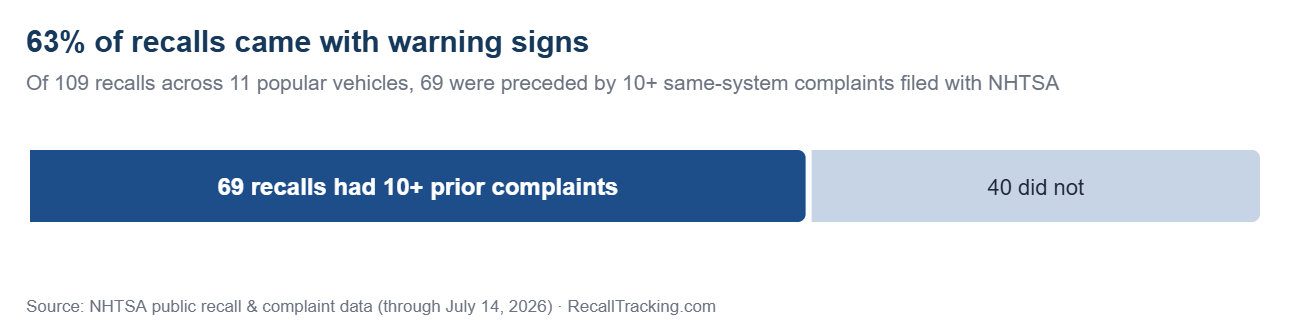
Here is what the data says: yes. NHTSA complaints are the public’s half of the recall system, and in our analysis of 109 recalls across 11 popular vehicles, 63% were preceded by ten or more complaints about the same vehicle system — warning signs sitting in the public record, sometimes for years, before the recall arrived.
The evidence that complaints count
Two findings from our studies. First, the warning-sign result above: for most recalls in our sample, the complaint file existed first — often years first (the median warning window was 4.9 years; the full analysis is in The Warnings Were There).
Second, volume predicts outcomes: vehicle systems that crossed 50 complaints were about 7.5 times as likely to have been recalled as systems with fewer than ten (that study is here). Correlation isn’t causation — popular vehicles get more of everything — but complaints are also, concretely, what NHTSA’s Office of Defects Investigation screens when deciding what to investigate, and investigations are a road to recalls. Your report is literally the raw material.
One more piece of evidence, our favorite: in the complaint files we’ve read, owners sometimes see it coming before the paperwork does. Six months before the 2013 Nissan Altima’s fourth air-bag-sensor campaign was reported, an owner filed a complaint relaying that “a new recall is coming” (that story is here).
How to file an NHTSA complaint that counts
File at nhtsa.gov/report-a-safety-problem (or 1-888-327-4236). It takes about ten minutes. What makes a complaint useful is specificity:
- Have your VIN. It lets NHTSA tie your report to a specific production run — which is how defect populations get defined.
- Name the component. The form asks which system was involved; choose the closest match. Component labels are how complaints get grouped and counted — a mislabeled complaint is a lost vote.
- Describe the incident, not just the frustration. Speed, what warned you, what the vehicle did, what a mechanic or dealer found. Dates and mileage. If there was a crash, fire, or injury, say so plainly — those fields drive attention.
- Attach what you have. Repair orders and photos can be uploaded.
- File even if a recall already exists for a similar problem on other vehicles. “My VIN isn’t covered but I have the same failure” complaints show up again and again in the files we read, in the years before campaigns get expanded.
What happens to it
Your complaint becomes a public record with its own ODI number, searchable by anyone — every complaint quoted in our articles is checkable that way. NHTSA screens incoming complaints, and clusters of similar reports can open defect investigations, which can lead to recalls (manufacturers also initiate most recalls themselves — with the same public record visible to them). You won’t get a case worker or a reply, and one complaint rarely moves anything alone. But the whole point of our research is that complaints act in aggregate, and aggregates are made of individual reports.
NHTSA complaint: quick answers
Is an NHTSA complaint public?
Yes — it becomes a public record with its own ODI number, searchable by anyone (personal identifying details are not published). That publicness is exactly why complaint files can act as early warning signs.
Does a single NHTSA complaint accomplish anything?
Rarely alone — complaints act in aggregate. Clusters of similar reports are what screeners notice, and every cluster is made of individual filings.
Should I also complain to the manufacturer?
Both is best: the manufacturer can open a case and authorize repairs; the NHTSA complaint puts the problem on the public record that feeds investigations.
About the data
Findings summarized here come from our two studies of NHTSA’s public records for 11 popular vehicles — 109 recalls, 20,495 complaints, 242 vehicle-system pairings (data through July 14, 2026; independently re-verified July 15, 2026) — and can be verified against the records at NHTSA.gov. Sample caveats and definitions: the methodology section of our flagship study.